Best Time To Visit Isla Contoy: Months, Norte Winds And Wildlife
Isla Contoy sits open all year except, officially, one month: January, when Norte winds usually keep the port shut. Everything else about picking a date, dry season, hurricane season, sargassum and the wildlife calendar, follows from that single fact.
Short answer
CONANP, the park authority, recommends visiting Isla Contoy all year except January, when Norte winds make port openings unlikely. Dry season runs November to April, the rainy season May to October, and hurricane season 1 June to 30 November. Reported peaks: frigatebird nesting November to April, turtle nesting roughly April or May to September or October.
Isla Contoy opens every day of the year, 9:00 to 18:00, subject to weather, and then immediately undercuts that generosity with one caveat: CONANP, the commission that runs the national park, recommends visiting all year except January, when Norte winds make it unlikely the port will open at all. That is the whole timing question in miniature. The island does not close for a season, the boats do, and the boats answer to the Port Captaincy, not to a calendar of your choosing. If your travel dates fall in that windy stretch, our explanation of whether Isla Contoy actually closes in January covers what the official advice means for a trip you already planned.
This guide walks through what each stretch of the year actually means for a Contoy day trip: the Norte wind window, the official hurricane season dates, the dry and rainy seasons, sea temperature, sargassum, and the reported wildlife calendar that makes some months more interesting than others. It also names the boat days that run through it all, from the Punta Sam eco adventure to the catamaran days and the Isla Mujeres departures, because a season only matters through the tours that sail in it. If you are still deciding where the island fits your trip at all, the Isla Contoy Tours homepage comparison and trip picker are the natural next stop.
When Is The Best Time To Visit Isla Contoy?
The best time to visit Isla Contoy is the dry season, November to April, with the single exception of January, when CONANP warns that Norte winds make port openings unlikely. Sea temperatures hover between about 25 and 29 C year round, so the date choice is about wind, rain and boat departures rather than water warmth.
The dry season, November to April, is when the Yucatan coast gets the steadiest combination of low rain, moderate wind and comfortable humidity, and that combination matters more here than at most Caribbean islands. Contoy is reached only by boat, about 25 km from Puerto Juarez, Punta Sam or Isla Mujeres, and a crossing that is pleasant in flat calm can be bumpy in a fresh wind. The same weeks line up with the reported frigatebird nesting peak, roughly November to April, which is a secondary but consistent operator-reported pattern worth weighing if birds are part of why you are going.
Within that window, January is the odd month out. A climate dataset puts Cancun sea temperature at its coolest in January to March, still a swimmable 25 to 26 C, but the real issue is the wind: Nortes, cold northerly fronts, sweep down the Gulf in winter and when they blow the Port Captaincy closes the port to the tour fleet. February to April therefore tends to be the sweet spot, dry-season calm with the January wind window behind you.
The other thing worth knowing about timing is that Contoy is capped at about 200 visitors a day (the management program counts 202), so the island never gets the cruise-crowd feel of mainland beaches no matter which month you pick. Crowds on your boat, not crowds on the island, are the variable you control, and that is a question of which listing you book rather than when. The tradeoffs between vessel types are covered in our catamaran versus speedboat comparison.
Why Does CONANP Warn Against January For Isla Contoy?
CONANP's official recommendation is that the park is suitable for visits all year except January, when Norte winds make it unlikely the port will open. Nortes are cold northerly fronts, and the Port Captaincy, not the operator, decides whether tour boats may sail.
A Norte is a northerly cold front that pushes down over the Gulf of Mexico in winter, bringing strong sustained wind and steep seas to the northern Quintana Roo waters exactly where Contoy sits. The park's own CONANP listing says it plainly: visitable all year, except January, because in that month the wind makes an open port unlikely. The management program for the beach sanctuary adds the mechanism, sailing to the island depends on the Capitania de Puerto opening the port to vessels. No open port, no boat day, however sunny your hotel balcony looks.
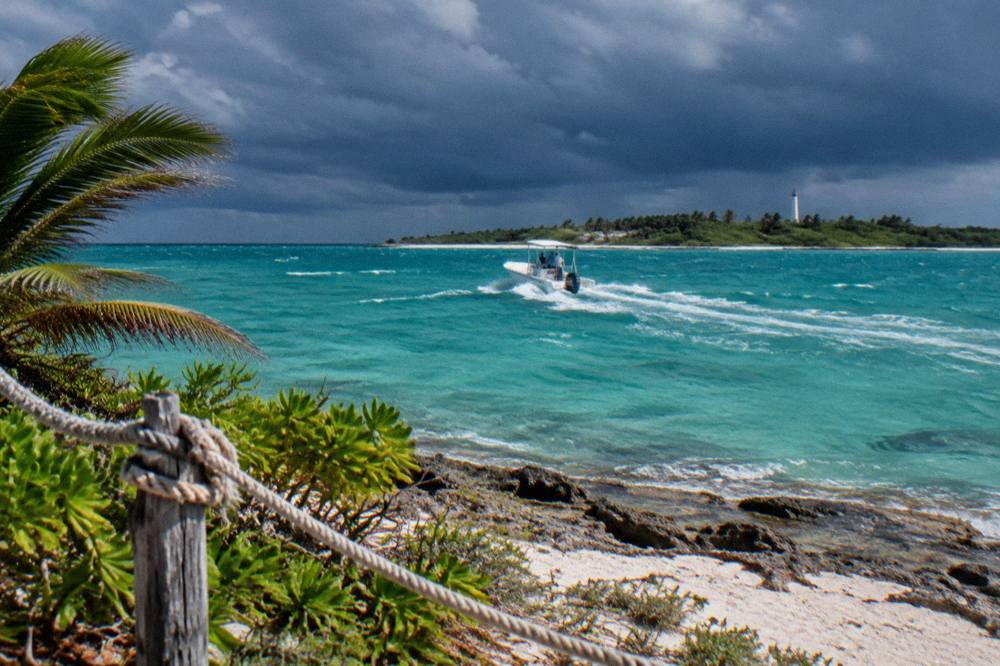
What this means in practice for a January trip is a real risk of cancellation, usually with a reschedule or refund rather than a lost deposit. Each listing states its own weather policy, and the shared pattern is a different date or a full refund when weather cancels the departure, while a skipped snorkel stop or a dropped Isla Mujeres visit is not, on the 10-hour catamaran listings, grounds for a refund on its own. Local press around Isla Mujeres and Contoy reports the fishing cooperatives preparing for the Norte season each year, which tells you how regular these fronts are. If the wind cancellations have you thinking about safety more broadly, our Isla Mujeres safety guide covers the ferry crossing, beach conditions and the current travel advisory in plain terms.
| Weather event on a Contoy day | What the listing typically offers | Watch-outs |
|---|---|---|
| Full weather cancellation before departure | A different date or a full refund, per the listing's weather policy | Rebook early in your stay so a new date still fits |
| Skipped snorkel stop at Ixlache reef | Day continues; the 10-hour catamaran listings state this is not refund grounds alone | Vest still mandatory whenever you do snorkel |
| Dropped Isla Mujeres stop | Day continues; not refund grounds on the 10-hour catamaran lines | The Contoy portion is the booked core of the day |
| Port closed by Norte winds or a storm system | Departure does not sail at all; reschedule or refund applies | Most likely in January and during passing hurricane-season systems |
If January is your only window, it is not a prohibition, it is a probability problem. Book with a free-cancellation or reschedule policy, keep a flexible day in your itinerary, and set expectations accordingly. February and March carry some residual Norte risk but the official warning is specifically January, and the wind pattern eases as spring arrives.
Whenever you go, the two listings below cover the main ways to do the day, and each runs year round outside weather closures.
Does Hurricane Season Affect Boat Days To Isla Contoy?
Hurricane season runs 1 June to 30 November, and in that window individual storms, not the season itself, stop Contoy traffic: ports close ahead of systems and reopen quickly once they pass. Operators list weather policies offering a different date or a full refund when a departure is cancelled.
The official Atlantic hurricane season definition, 1 June to 30 November, overlaps almost exactly with the region's rainy season, May to October. That sounds alarming, but a hurricane is a discrete event measured in days, not a state of the month. What actually happens when a system approaches is procedural: the Port Captaincy restricts or closes navigation, small vessels are the first tied up, and tour departures including Contoy trips pause. Regional press documented exactly this in early October 2026, when ports around Isla Mujeres were closed to smaller boats ahead of a passing hurricane and reopened as the system moved on.
So a July or September Contoy trip is entirely normal; those months are simply the ones where you should read the operator's cancellation wording before booking rather than after. Two patterns are worth checking on any listing you consider. First, whether a weather cancellation earns you a full refund or a rescheduled date. Second, whether partial changes, a skipped snorkel at Ixlache reef because the sea is up, or a dropped Isla Mujeres stop, are treated separately. On the catamaran tours they are: the listing states those skips do not themselves trigger a refund, because the operator still delivered the day.
The eco adventure run by Contoy Adventures out of its own marina at Punta Sam, from $140 per person, 8 hours, with open bar and snorkel gear listed, is a good example of the year-round shape of these products: the listing states a maximum of 50 travelers, roundtrip transport from Cancun and Playa del Carmen hotels, and it sails in every month the port opens. Its 4.3 rating from 209 reviews reflects a lot of seasons of operation.
One planning note for storm-season months: keep your Contoy day early in your stay rather than on the last day, so a rescheduled departure still fits your trip if the wind decides otherwise.
Should You Worry About The Rainy Season On The Island?
The rainy season runs May to October, but on a small offshore island it shows up as afternoon showers and higher humidity rather than all-day rain, and the sea stays warm, a climate dataset puts Cancun water at about 25 to 29 C across the year. Rain rarely cancels a Contoy day; wind does.
Rain in the Yucatan summer is typically convective: building cloud through the morning, a heavy burst in the afternoon, then clearing. A Contoy itinerary puts you on the boat in the morning and on the island around midday, so a rainy-season day often delivers sun for the crossing, a shower over lunch under the palapa, and a fresh afternoon. The listing for the 10-Hour Nature Expedition by Pescado Adventures, 10 hours from $139 per person with a $60 per person second final payment stated separately, is built around exactly that rhythm: three hours on Contoy with lunch, guided tour, swimming and wildlife viewing, then a boat cruise and an Isla Mujeres visit on the way back.
| Season on the coast | Months | Typical day pattern on a Contoy trip | Sea temperature |
|---|---|---|---|
| Dry season | November to April | Sunny, moderate wind, low rain chance, cooler evenings | About 25 to 27 C, coolest January to March |
| Dry-season exception | January | Norte winds make port opening unlikely per CONANP | About 25 to 26 C |
| Rainy season | May to October | Hot and humid, morning sun, afternoon shower possible | About 27 to 29 C, warmest July to September |
Humidity is the main downside of May to October. It is hot, the shade is welcome, and the mangrove trails can carry mosquitoes, a point several guest reviews of the island raise. That is a packing-list problem more than a timing problem, and it applies to the winter months too, just less so. Long sleeves, a hat and repellent applied before boarding handle most of it, which is also what our what to bring guide covers in detail, along with the island's strict no-sunscreen rule.
The quiet bonus of the rainy-season months is space on the boats. Dry-season high season fills the catamaran days and speedboat days faster, while June to October, outside the July and August school-holiday spike, tends to have more availability at shorter notice, and the island's own visitor cap means the beach never feels crowded even when the boats are full.
What Is The Month-By-Month Weather On Isla Contoy?
The year splits cleanly in two: dry season November to April with lower rain and the January Norte exception, and rainy season May to October with heat, humidity, afternoon showers and hurricane-season overlap. Sea temperature moves only from about 25 C in the coolest months to about 29 C in the warmest.
A climate dataset puts Cancun's monthly sea temperatures in a narrow band, coolest around January to March at roughly 25 to 26 C and warmest around July to September at roughly 28 to 29 C. For swimmers and snorkelers that difference barely registers; you will be in the water either way, and at Ixlache reef the life vest is mandatory in every month. Air temperatures follow the same gentle curve, with the dry season pleasantly warm and the rainy season hot and humid.
| Stretch of the year | Season label | What it means for a Contoy day | Main risk |
|---|---|---|---|
| November to December | Dry season starts | Calm crossings, reported frigatebird nesting underway | Early-season Nortes possible |
| January | Dry season, official exception | CONANP warns port opening unlikely due to Norte winds | Cancellation likelihood high |
| February to April | Dry season core | Steadiest wind and rain combination of the year | Peak booking demand |
| May to June | Rainy season starts, hurricane season opens 1 June | Hot, humid, afternoon showers, good availability | Isolated storms |
| July to August | Rainy peak, holiday crowds | Warmest sea, busiest summer weeks | Storms, fuller boats |
| September to October | Late rainy season | Quietest tourist weeks, storms possible | Hurricane-season systems, sargassum peak |

Two cautions on that table. First, it describes the climate pattern, not a forecast; any given week can misbehave in either season. Second, the wildlife entries are reported patterns from operator and birding sources, not promises, and the island's rules rightly forbid disturbing any of it.
When Can You See Birds And Turtles Around Isla Contoy?
Isla Contoy has well over 150 recorded bird species resident or passing, with the magnificent frigatebird colony, one of the region's largest, reported to nest roughly November to April. Three sea turtle species nest on the sanctuary beaches, reported roughly April or May to September or October, but no tour promises a sighting.
The bird calendar is the one place where the timing question and the wildlife question give the same answer. Frigatebird nesting, reported roughly November to April, with courtship displays at its most visible early in that window, sits inside the dry season and outside January. The colony itself is present all year, as are brown pelicans, double-crested cormorants, brown boobies and royal terns, so a summer visitor misses nothing but the peak of courtship. The red-footed booby colony is called the only nesting one in Mexico by operator sources, and it is resident too, with a reported visibility peak November to March.
| Species or event | Present on the island | Reported peak window | Source status |
|---|---|---|---|
| Magnificent frigatebird | All year, resident colony | Nesting roughly November to April | Secondary, operator-reported |
| Red-footed booby | All year, resident colony | Visibility reported November to March | Secondary, operator sources |
| Brown pelican, cormorant, brown booby, royal tern | All year, resident colonies | Nesting activity reported in spring and early summer | Secondary |
| Sea turtle nesting (hawksbill, loggerhead, green, leatherback) | Beaches of the sanctuary | Roughly April or May to September or October | Secondary, reported |
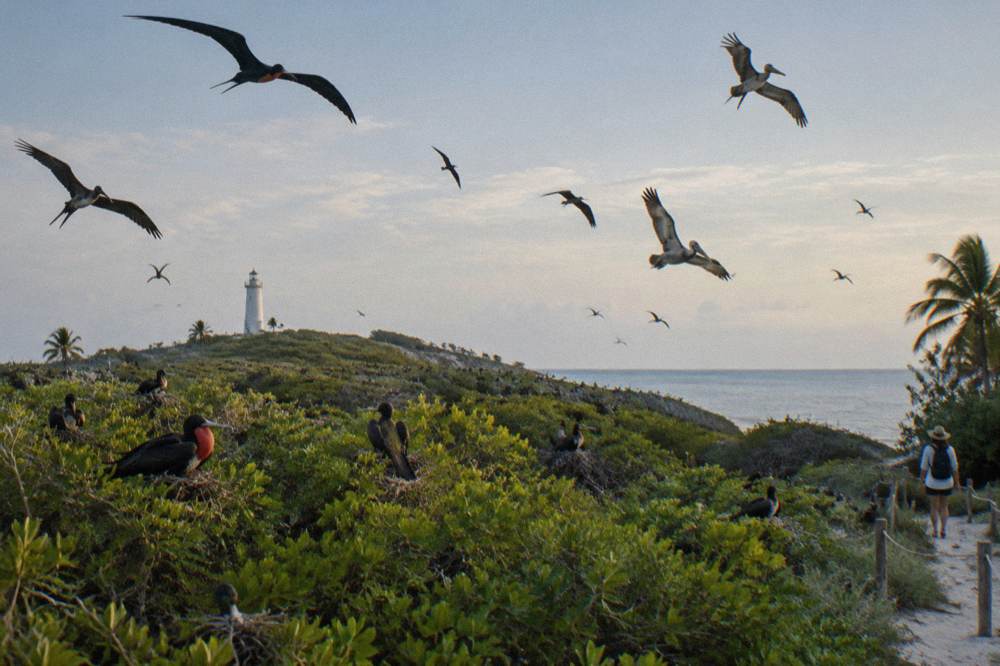
Turtles are the more delicate subject. The sanctuary protects three nesting species, hawksbill, loggerhead and green, plus occasional leatherback records, with nesting reported roughly April or May through September or October. Hatchling viewing windows are not public and no tour includes them, so treat any summer turtle encounter as a possible grace note rather than a booked feature. What a summer trip does give you is the nesting season itself, which is why the wildlife and sea turtle guide treats May to September as its most interesting stretch. The birding side of the calendar, including the eBird hotspot list of 183 species, is covered in our Isla Contoy birdwatching guide.
Guided walks on the island's interpretive trails are mandatory, with a certified guide, in every season, and that is where nearly all bird viewing happens: the lagoon boardwalks, the dune scrub and the viewpoints over the mangroves. None of this depends on luck so much as on quiet feet and a good guide, which every authorized operator must provide by rule.
Is Sargassum A Problem On Isla Contoy?
Sargassum season in the Mexican Caribbean runs roughly May to October, but Isla Contoy's northern position is repeatedly reported as cleaner than the exposed Riviera Maya mainland beaches, and conditions vary week to week. No listing promises sargassum-free sand.
Sargassum, the floating brown seaweed that carpets southern-facing beaches in bad years, arrives on the prevailing conditions of the late spring through fall. Monitoring of the northern Quintana Roo islands has repeatedly reported them low in sargassum or free of it while mainland hotspots to the south collect it, because currents and the reef buffer the northern shores. Contoy, Holbox and parts of Isla Mujeres are the names that keep coming up as the cleaner option in season, though satellite monitoring shows variability, and cloud cover sometimes hides the picture entirely.
For a summer trip: sargassum is a mainland-beach problem that Contoy mostly dodges, but it is weather-dependent, not guaranteed absent. If your dates fall in May to October and pristine sand is the priority, the island is one of the better bets on the coast, and a same-week check of the live monitoring maps before you travel tells you more than any calendar can. In the dry season, November to April, the question mostly answers itself: arrivals are minimal and the beaches read as postcard-white.
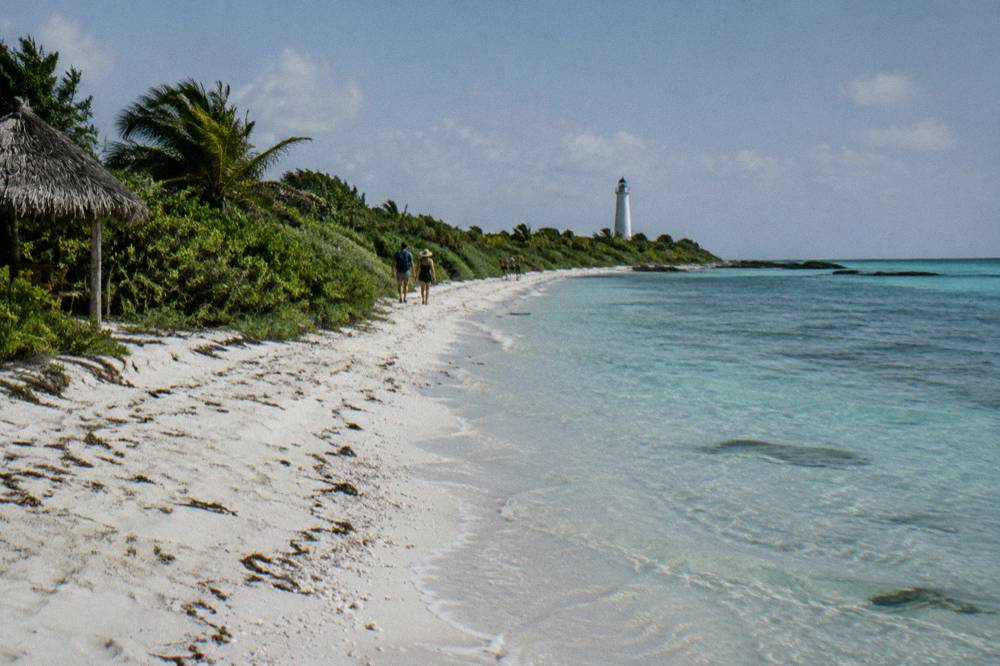
It is one more reason the authorized-boat-only rule exists; the operators adjust to conditions on the day.
Which Isla Contoy Boat Days Run In Every Season?
All fourteen tours run year round outside weather closures; the differences between them are departure point, vessel and inclusions, not season. Ten offer hotel pickup with the boat day, four require reaching a meeting point yourself, and each states its own fee and weather terms.
Season picks the odds of sailing, not the menu of boats. From Cancun and Playa del Carmen, the Snorkel Day, 8 Hours by Ocean Tours Mexico, from $179 per person, 8 hours, 4.8 from 829 reviews, the most reviewed listing, sails from the Flamingos pier with hotel pickup and drop-off listed, lunch and drinks included, and a US$20 per person government fee stated as paid on site, not in the booking price. Its itinerary allots three hours at the national park itself plus a one-hour Isla Mujeres stop on the return.
From Isla Mujeres, where the crossing to Contoy is reported at roughly one to one and a half hours, as little as 45 minutes on some routes, the National Park, Optional Snorkel by Isla Fun Tours departs the Black Pearl dock downtown, from $136 per person, 6 to 7 hours, 4.6 from 35 reviews, with an optional snorkel stop at Contoy and a traditional lunch listed. The listing states no on-site fee line, and the meeting point is reached on foot, no hotel pickup. It is the shortest, cheapest way onto the island, and it pairs naturally with a stay on Isla Mujeres, a base we compare against Cancun in our where to stay guide.
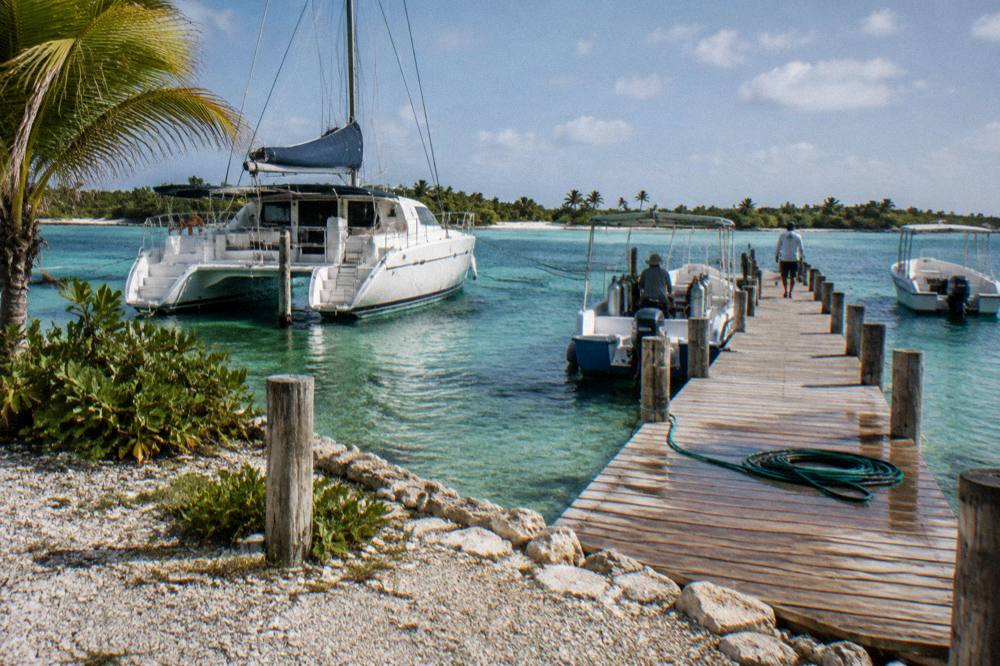
The catamaran options, including the sailing day from Marina Xtabay with check-in from 9:30 and a 10:00 departure, are the most weather-sensitive of the lot simply because a sailing schedule answers the wind first, and the two 10-hour catamaran listings say a skipped snorkel or Isla Mujeres stop is not refund grounds on its own. Whichever hull you choose, book through the operator's live listing and check your exact date there, for example on the Eco Adventure, 8 Hours, before locking in hotels.
| Departure style | Example listing | Season behavior | Notes for storm-season booking |
|---|---|---|---|
| Speedboat day with hotel pickup | Snorkel Day, 8 Hours, from $179 per person | Sails year round outside port closures | Itinerary lists 3 hours at the national park |
| Eco adventure from Punta Sam | Eco Adventure, from $140 per person | Year round, own marina next to the ferry terminal | Listing states a maximum of 50 travelers |
| Catamaran and sailing days | Sailing Catamaran day, from $139 per person | Most wind-sensitive schedule | Check the listing's weather terms |
| Isla Mujeres departure | National Park, Optional Snorkel, from $136 per person | Shortest reported crossing, about 1 to 1.5 hours | No hotel pickup; reach the Black Pearl dock yourself |
| Private speedboat charter | Private 8-Hour Snorkel Day, from $840 per group | Sails year round outside port closures | Group size not stated in the listing |
Is The Park Itself Ever Closed Outside January?
No seasonal closure exists beyond the weather mechanism: the park is listed open every day, 9:00 to 18:00, subject to conditions, and no turtle-nesting or maintenance closure is published. Closures happen day to day, by port decision, not by season.
This is a distinction worth insisting on because the internet is fond of vague "closed in winter" claims about Contoy. The official CONANP page gives daily hours with no weekday closure and no seasonal closure, and the management program for the beach sanctuary restricts activities through sub-zoning, lighting rules and nesting protections, not through visitor seasons. What the documents do establish is the January recommendation, the 202-person daily capacity, and the mandatory-guide rule on the trails, all of which operate every month.
| Official rule from CONANP or the management program | Applies in which months |
|---|---|
| Open every day 9:00 to 18:00, subject to weather | All year |
| Recommendation to avoid January due to Norte winds | January |
| About 200 visitors a day (management program counts 202) | All year |
| Marked trails only, with a mandatory guide | All year |
| No sunscreen or blocker, stop 30 minutes before arrival | All year |
| Life vest mandatory for snorkeling at Ixlache reef | All year |
The practical reading for a traveler: there is no bad month to book, only months with different risk profiles. February to April carry the lowest cancellation odds. May to October add heat, rain, sargassum season and hurricane-season overlap, offset by warm sea, reported turtle nesting and easier availability. January is the one month the park authority itself tells you to avoid, and the only one where the odds of your boat not sailing are high enough to plan around, which our explainer on whether Isla Contoy closes in January covers in full. If your itinerary pairs the reserve with time on the neighboring island, our month by month guide to the best time for Isla Mujeres applies the same tradeoff logic to that leg of the trip.
Common Questions About The Best Time To Visit Isla Contoy
Is Isla Contoy Closed In January?
The park posts no closure, but CONANP recommends against January visits because Norte winds make it unlikely the port will open. In practice that means a high chance your tour is rescheduled or refunded rather than sailed. February onward eases the risk.
Does Hurricane Season Cancel Isla Contoy Day Trips?
Hurricane season runs 1 June to 30 November, and individual systems close ports for days at a time rather than blanketing whole months. The tours' weather policies offer a different date or a full refund when a departure is cancelled, while skipped snorkel or Isla Mujeres stops are not refund grounds on the 10-hour catamaran listings.
When Is Turtle Nesting Season On Isla Contoy?
Three species, hawksbill, loggerhead and green, plus occasional leatherback records, nest on the sanctuary beaches, with nesting reported roughly April or May to September or October. No tour promises turtle sightings and hatchling viewing windows are not public, so treat any encounter as a bonus.
Is There Sargassum On Isla Contoy In Summer?
Sargassum season runs roughly May to October across the Mexican Caribbean, but Contoy's northern position is repeatedly reported as cleaner than the mainland Riviera Maya beaches in season. Conditions vary week to week, so check live monitoring shortly before travel.
Is The Sea Cold Around Isla Contoy In Winter?
No. A climate dataset puts the water at about 25 to 26 C in the coolest months, January to March, rising to about 28 to 29 C in July to September. Snorkeling is viable in every month, with a mandatory life vest at Ixlache reef.